Access to fresh and affordable food is a right.
A Fresher Place does not sell food. We are the software that lets your neighborhood sell it to itself. A family finds the crops they cook with, reserves a share, and picks it up somewhere they already go. The farm keeps the whole food dollar.
Making the world a fresher place.
Go back and fetch it.
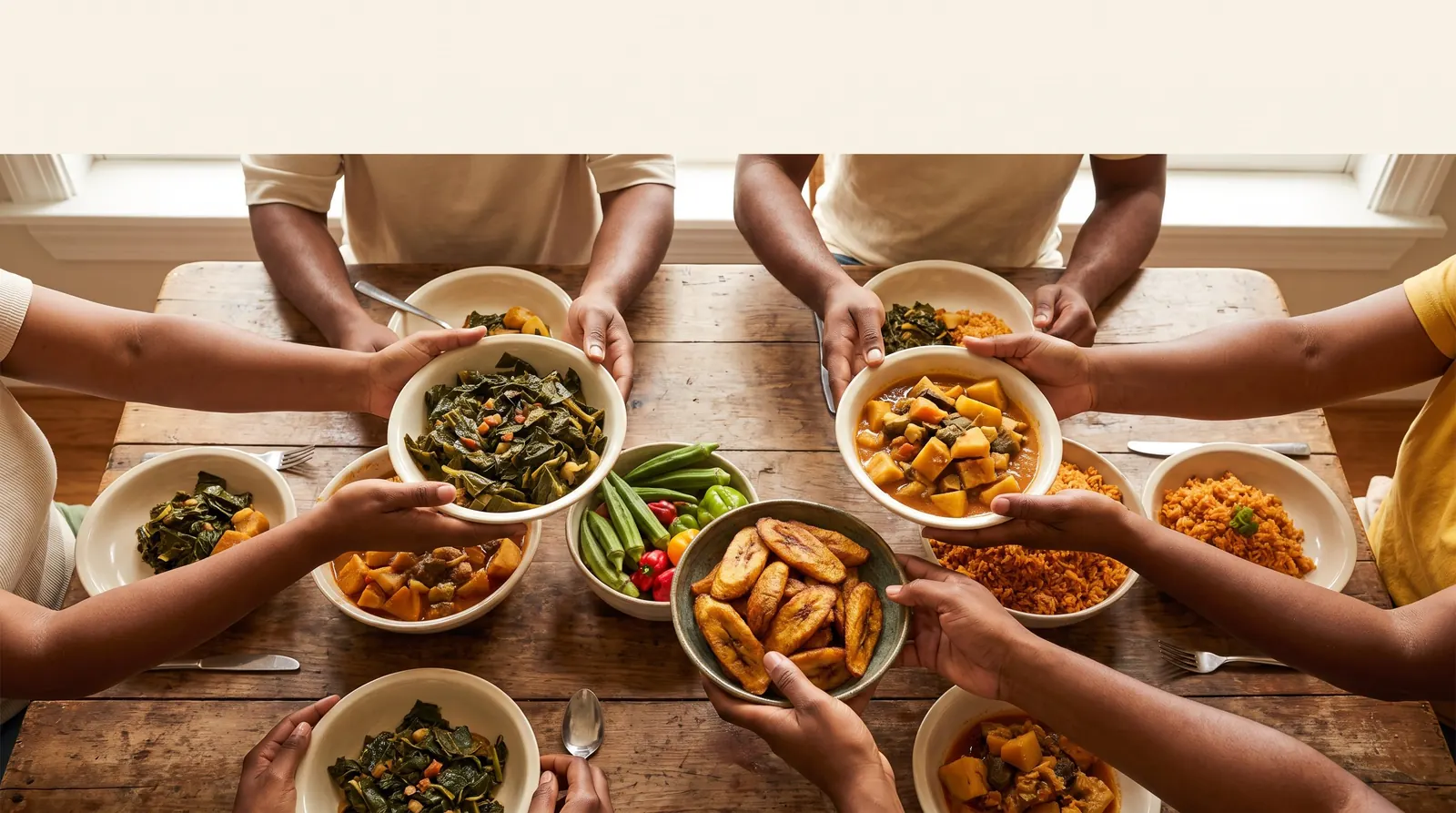
We have always done this. Families pooling for the harvest. Elders deciding what gets cooked. Children eating greens that take all day. A Fresher Place is not a new idea. It is the old idea, brought back with the technology to make it work on your block again.
For families paying with EBT and families paying with card.
The same weekly box. The same farm. The same pickup at the library, the senior center, the housing development.
Foodways Library
We make healthy food visible, accessible, and affordable.
Moringa
Moringa holds a special place in African and Caribbean food traditions as much more than a plant; it is a symbol of life, resilience, and self-determination.
African Eggplant
The African Eggplant holds a profound place within African and Caribbean food traditions as a symbol of resilience, heritage, and community survival.
Bitter Leaf
Bitter Leaf holds a place of deep respect across African and Caribbean food traditions as a symbol of resilience and continuity.
The money never leaves
Families pay the farm directly. A Fresher Place never touches the food dollar and takes no cut.
Ownership, not charity
Access moves through community bodies people already trust, and the community comes to own the infrastructure.
Food is medicine
Fresh, culturally meaningful food is not a luxury.
The problem is rarely that there is no store.
For many low-income families in a city full of grocery stores, the food that fits their culture is still too far, too expensive, or simply not carried, and what is carried keeps climbing with grocery inflation. Meanwhile the dollars a family spends on food leave the neighborhood for distant chains, and the local farms that could serve them have no affordable way to reach them. Limited access to fresh food pushes families toward processed food. A Fresher Place reverses that engine: keep the dollar circulating locally on fresh, culturally meaningful food. That is why we treat this as a poverty problem, not a convenience one.
We are the software front door, not a food distributor.
A Fresher Place is built and run as a software company. We hold no inventory, run no trucks, and take no cut of the food dollar. The model is simple: a family finds a farm carrying their cultural crops, reserves a share, and picks it up in their own neighborhood, paying the farm directly. It works on any phone with nothing to download, in multiple languages, and accepts SNAP and EBT. Benefit matching programs are run by states and local organizations, not by A Fresher Place, so what is available depends on where you live.
The money never leaves.
The food dollar runs from the family to the farm directly, through each farm's own payment account. A Fresher Place never touches it and takes no cut, so it stays entirely in the community.
The platform dollar is the only thing A Fresher Place funds for itself: the lean software layer, carried by our parent company's earned revenue and, over time, our own earned lines.
The subsidy dollar, from grants and institutional contracts, pays the community roles directly, never through our balance sheet. Grants grow the model into new cities; they are not life support.
The family pays the farm, not us. That is the technical proof we take no cut, not a promise.
A Fresher Place charges no commission and takes no cut of the food dollar. Standard payment-processing fees set by the processor, for example Stripe or Square, still apply.
Five roles run the loop. None of them are ours.
Five roles run the loop in every city: the grower, the host, the translator, the chef, and the steward. Nobody is on our payroll. The platform is built and maintained in-house, and the money that pays these roles reaches them through the community's own entity and through grants that fund them directly, never through our balance sheet.
- Grower: The local farms that grow the culturally specific crops.
- Host: The trusted neighborhood site that hosts pickups.
- Translator: Bridges language and culture so the platform meets families where they are.
- Chef: Carries food-as-medicine and cultural knowledge through classes and recipes.
- Steward: The neighbor who signs up families and keeps the last mile running.
These are the seats that govern the loop. The ways to join are broader: farms, hosts, chefs, stewards, nonprofits and institutions each have their own door. Partner with us.
The tradition we continue.
A Fresher Place did not invent the idea that a community should own how it feeds itself. We are carrying a proven tradition forward, with a lean, replicable technology layer its founders never had.
Fannie Lou Hamer
She built the Freedom Farm Cooperative in 1969, turning food and land into community economic power owned from the neighborhood rather than administered from above. She also named the weakness we are built to fix: it ran short of money, leaning too heavily on her own fundraising. A Fresher Place funds only a lean platform, so the model does not depend on one person to survive.
Ella Baker
She spent five decades putting power in the hands of ordinary local people rather than a single leader. That is why the community comes to own the infrastructure, not the platform.
George Washington Carver
He taught that food is medicine and gave the knowledge away free. Our food-as-medicine library and our refusal to gate knowledge descend from him.